The local optimum of power

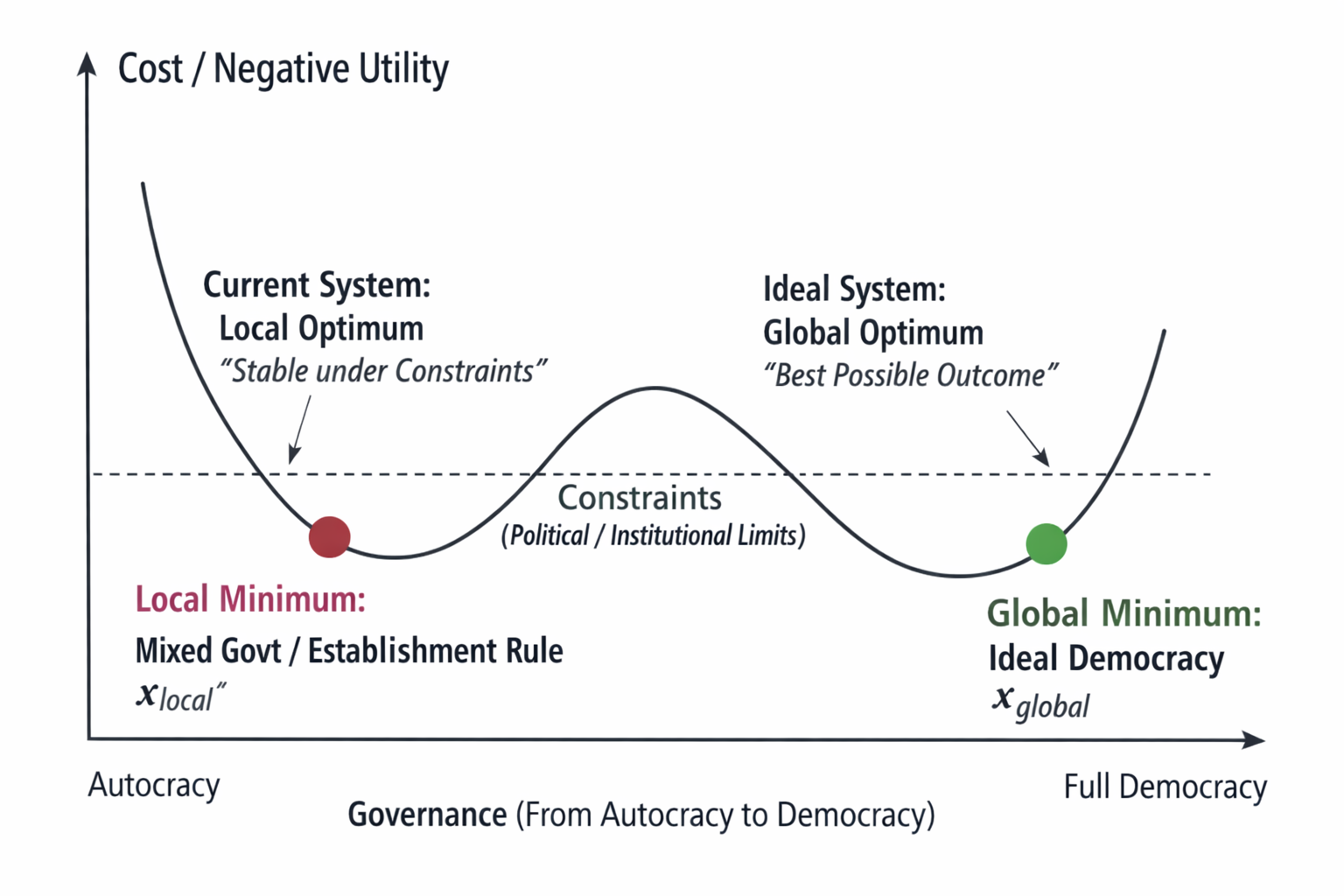
An optimal solution is not always the best one in absolute terms. Often, it is a local optimum, a solution that can enable a system to function effectively without disruption.
In optimization theory, the global optimum is the best overall solution. A local optimum, while not perfect, can perform remarkably well within its constraints. Importantly, it may deliver much of the effectiveness of the global optimum, even if it falls short of the ideal.
This perspective aligns with Pakistan’s mixed political structure, in which absolute power often resides with the Establishment. When judged against global standards shaped mainly by Western democracies, the system may appear suboptimal. Yet in practice, it embodies elements that can provide continuity, stability, and functional governance. In optimization terms, it represents a working local optimum.
The risk arises when a functioning local optimum is destabilized in pursuit of a distant global ideal. History shows that dismantling a working system can create more harm than good.
Optimization offers a sobering lesson: the best solution on paper is not always the best solution in reality. Sometimes, improving a local optimum is wiser than forcibly pursuing an idealized global optimum.
The success of democratic systems in Europe and the United States has led to a widely held axiom that democracy is the best form of governance. However, assuming its universal applicability is an oversimplification of structural differences across societies.